How do Pensions Work?

A pension is a tax free way to save for your retirement. There are a number of ways to save for a pension and various types of pension schemes available including state pensions, workplace pensions and personal pensions. The pension plan you choose will depend on a number of factors including your age, salary, financial situation and the company you work for.

Pensions and Retirement

Department for Work and Pensions

The Pensions Advisory Service

Online Pension Planner

How much is a State Pension?

The current maximum amount of basic state pension you can claim is £107.45 weekly (as of October 2012) and the maximum state pension amount increases annually.

Once you reach state pension age you will be able to claim the basic state pension, however you must have paid National Insurance (NI) contributions or have been credited with NI contributions during your working life. Continue reading “How do Pensions Work?”

Lizzie from Texas: I loved London!

Back in November when we published our Time for a Cuppa infographic, we got in touch with two lovely ladies – Pippa and Jules – otherwise known as the Darjeeling Darlings, who are based in San Antonio, Texas, and absolutely adore good quality tea.

Reading their reviews of Tea Rooms across Virginia, Florida, Texas and California, we couldn’t help but notice one additional participant of those little afternoon tea parties – someone we here in the UK are rather familiar with, who they refer to as Lizzie.

Among other things, we wrote in our email:

“We absolutely loved your Lizzie, she has a great taste and seems to really love tea. Just out of interest, has she actually been over here in the UK? If not, why don’t you post her over, and we will take a photo of her in front of the Buckingham Palace? Just an idea!”

It took a while to pack (all those dresses, hats, handbags and jewellery!) but guess who arrived at our LondonOfficeSpace.com office earlier this month?

Her Majesty the Queen! Continue reading “Lizzie from Texas: I loved London!”

The Royal Mint Court Building Welcomes New Businesses

Royal Mint Court Building LondonOfficeSpace.com @officeinlondonOn Royal Mint Street, opposite the Tower of London, stands the Royal Mint Court building. It is Grade II listed, recently repurposed for commercial means and blends classic architecture with contemporary style and function. The site was originally home to a Cisterian Abbey from the 14th to the 16th Century; St Mary De Grace was sometimes affectionately called Eastminster Abbey, belying its architectural and historical significance. Later, in 1562, after the dissolution of the monasteries, the Royal Navy took over and used the site as a victualling yard. Following this, it changed hands again in 1784, when a tobacco company used it to store their goods.

Sir Isaac Newton was Master of The Royal Mint from 1699 to 1727 and during that time, The Mint was still housed, as it had been for 500 years, at the Tower of London. As the minting process became mechanised throughout the eighteenth century, a new building was commissioned by King George III on the site of the tobacco warehouse opposite, to the east. A committee was appointed, two architects were chosen, James Johnson and Robert Smirke and construction began in 1807. James Johnson died in 1807 and never saw the new building finished but Robert Smirke saw it through to completion and then went on to receive plaudits for his design of the British Museum. Part of Royal Mint Court is still called the Johnson Smirke Building in their memory. The Royal Mint Court remained the home of the minting process until 1975, with the introduction of decimalisation when the procedure was moved to Wales. Continue reading “The Royal Mint Court Building Welcomes New Businesses”

A Closer Look at South Bank’s Business Centres

London's Southbank in the Morning @officeinlondonLondon’s South Bank is an area buzzing with activity; a hub for creative arts, and attractions for tourists and locals alike, it is alive with people day and night, all year round. It is packed with restaurants, bars, cafes, theatrical and artistic venues and places of business, all on the very edge of the River Thames and within easy reach of a number of different transport options. This bustling and lively district is home to a number of office buildings which cater to and look after the requirements of the kinds businesses that want to place themselves amid the hubbub and action.

On Black Prince Road sits the impressive and eye-catching Southbank House. Originally built in the early nineteenth century as the headquarters of Royal Doulton, it now provides fully serviced office and studio space for flexible terms and to accommodate companies comprised of 1 – 25 people. The facilities include 24 hour access and reception, a cafe and showers and the spaces boast natural light and many original character features which appeal to business including architectural firms, environmental consultants and chartered surveyors. The nearest tube is Lambeth North (Bakerloo Line), head south on Kennington Road, take a right on Lambeth Road and left onto Lambeth Walk, finally turn right onto Black Prince Road. Southbank House is also in walking distance to the river and Waterloo Station.

Waterloo Business Centre is located in a desirable spot, overlooking one of London’s finest theatres, The Old Vic and within a 2 minute walk down Waterloo Road from Waterloo Station. The fully serviced offices are available in a range of sizes and the building boasts a communal area for meetings. Continue reading “A Closer Look at South Bank’s Business Centres”

Explore Bond Street: History, Architecture, Business and Tourism

Bond Street was first laid out in 1680. At that time, only the section known as Old Bond Street existed. In 1720, the street layout was completed with a further section that is now New Bond Street. Nowadays, Old Bond Street runs between Burlington Gardens and Piccadilly, while New Bond Street is the northern section that connects with Oxford Street.
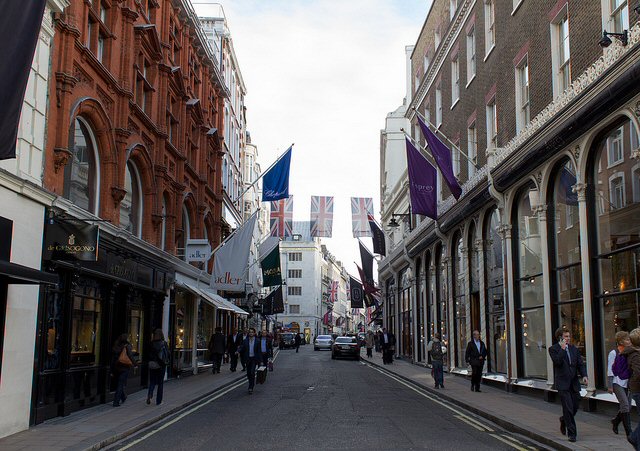
Bond Street LondonOfficeSpace.com @officeinlondon
(Image © M Hooper)

Bond Street was named after its developer, Sir Thomas Bond. In the late seventeenth century, the area that is now known as Old Bond Street was occupied by a mansion called Clarendon House. This was one of London’s most expensive properties at the time. Following Lord Clarendon’s death, the property was sold and demolished, giving way to what today is known as Old Bond Street.

For over one hundred years, Bond Street has been one of London’s most exclusive shopping destinations, particularly for those looking to buy antiques, art, or jewellery. The internationally renowned Sotheby’s auction house has been based in Bond Street since 1917, and the same can be said about the Fine Art Society, which has been at this London address since it was first inaugurated in 1876.

Information on commercial real estate prices in Bond Street

According to the Cushman & Wakefield Main Streets Across the World report for 2011, Bond Street commercial real estate prices were the sixth highest in the world, only preceded by the Champs Elysées, Tokyo’s Ginza Avenue, Hong Kong’s Causeway Bay, and New York’s Fifth Avenue. At the time of the survey, retail premises were being priced at £577 per square feet. At European level, Bond Street is the continent’s second most expensive street. Continue reading “Explore Bond Street: History, Architecture, Business and Tourism”