
Cost of Office Space in London – Startup Survival Guide

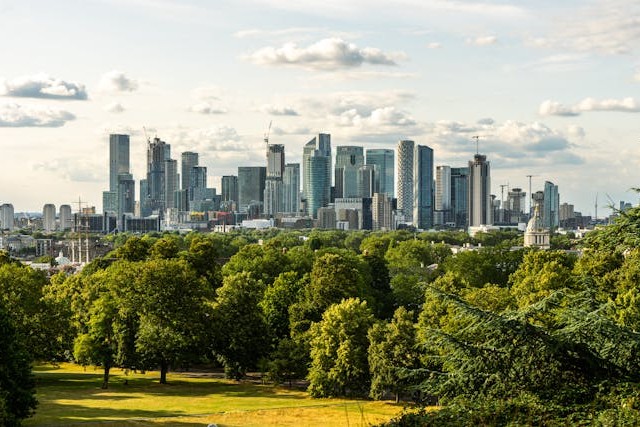
A daytime view from the lush and expansive green surrounds of Greenwich Park towards the skyline of London’s business district. The Greenwich area is to the south-east of central London, and the cost of office space there is much more affordable than the city’s core, ideal for startup survival if they are cash-strapped. Image at LondonOfficeSpace.com.

Cost to Rent Office Space in London: At-A-Glance

Aspect Central London Outskirts/Outer Boroughs
Cost High rents and high business rates. £70-£88 / sqft for Grade A office space in The City. Lower rents and overheads. Averages of £30 / sqft for North London outskirts locations.
Startup survival Prone to burn through capital Extended runway boosts resilience
Brand signal Conveys prestige and trustworthiness Matches modern and agile brand narratives
Ideal sectors Finance/Insurance/Legal startups Tech and creative 

For startups in London, choosing an office location isn’t just a logistical decision: it’s a strategic move with real implications for cost control, client perception, and long-term survival. The choice between setting up a serviced office space in central London postcodes or in the outskirts is often one of the most important financial decisions a company will face at its earliest stage.

To help with that decision, in this article, we offer a data-driven analysis of the pros and cons of each option to rent office space, comparing costs, survival rates, and brand impact from central London and outer borough offices.

Continue reading “Cost of Office Space in London – Startup Survival Guide”

What is an Office Brokerage—and Why Use One to Find Office Space in London?

A golden hour view of the London skyline featuring The Shard and Walkie Talkie buildings, highlighting the prime office space locations for businesses using a brokerage in 2025. Image at LondonOfficeSpace.com.

In an age where office space search platforms list hundreds of commercial properties at the click of a button, it’s easy to assume that office brokers are redundant.

But in today’s complex London office market—where prime rents are rising, and office space availability is tightening (especially for premium, new office space in high-demand locations)—the question isn’t why brokers still exist, but rather, why use an office space brokerage in 2025?

Yes, you can now hop on any number of search platforms and, in seconds, be armed with a comprehensive overview of the London office market and rental rates, but there is no algorithm yet that replaces the value of expert lease negotiations, office broker relations, deep market knowledge, and real-world cost-cutting strategies.

Real-World Experience With a London Office Broker

Simon Lee, CEO of app development firm Glance, recounts his experience of using a brokerage: “We compared 30 off-market units and signed a five-year lease at 18% below asking,” he shared. “Our broker wrapped rent, cleaning, and business rates into one tidy monthly invoice.”

That efficiency allowed Glance to transition from a 10-desk co-working pod to a 35-seat office in Shoreditch without losing control of costs or flexibility.

Continue reading “What is an Office Brokerage—and Why Use One to Find Office Space in London?”

The Best Postcodes in Central London for Your Office

Dusk view down the River Thames of the illuminated Tower Bridge spanning the river with a purple and blue cloud-strewn sky in the background and riverbanks lined with buildings with postcodes in Central London.

Following the widespread adoption of remote work during 2020 and 2021, the majority of industry sectors are returning or have already returned to the office.

During this period, employee expectations regarding the office environment have changed. For example, many companies now report that staff increasingly demand shorter commutes, dedicated collaboration and relaxation space within the office, and upgraded amenities.

As a result, many business owners are considering downsizing and/or relocating their offices so the new location meets the needs of existing staff and future hires.

Since location is a key consideration, let’s look at what the most desirable central London postcodes are for your office in 2023 and beyond.

Continue reading “The Best Postcodes in Central London for Your Office”

Benefits and Incentives for London Small Businesses and Startups in 2021

Recent events have illustrated the fragility of businesses in highly competitive markets. Small businesses and start-ups were thrown into disarray as potential clients, suppliers, customers, and employees were all heavily impacted by the new normal of the COVID-19 pandemic. Businesses across the world, both new and established, turned to support mechanisms to stay afloat. Business grants and incentives, often provided by the government or local councils, served as the difference between some businesses surviving and being forced to shutter their doors. These grants, often characterised by non-existent interest rates and obligations to pay back, are highly sought after in the London business scene, particularly in times of uncertainty.
Commonly regarded as one of the world’s best places to establish a business, London is home to countless such grants, loans, and incentives, ranging from small monetary rewards to life changing assistance packages that allow businesses to quickly establish themselves and acquire the tools or equipment necessary for continued success.

Continue reading “Benefits and Incentives for London Small Businesses and Startups in 2021”

An Overview of Coworking Spaces in London

London offers a wide variety of coworking spaces located in high spec buildings, complete with modern facilities, no initial capital commitments, and excellent flexibility with no exit costs.

Coworking spaces are highly appealing to businesses for a number of reasons, chief of which being the fact that they’re commonly plug ‘n play, no matter if you’re looking to rent a single desk or an entire floor. With coworking spaces there is no need to worry about buying furniture, committing time and effort to fit outs, and negotiating tedious lease agreements.

In addition to their plug ‘n play nature, coworking spaces in London provide:

  • Flexibility: In terms of the cost and length of contracts, which makes this type of space suitable for small businesses and helps them manage their finances better during the initial stages.
  • Range of Options: The growing popularity of this office space arrangement means that there is a wide range of options to choose from.
  • High Specifications: Modern facilities in high-spec office buildings, whether they are purpose built or refurbished.
  • Networking Opportunities: An open plan and communal atmosphere that promotes collaboration, networking, and can help establish new partnerships that could be crucial to the development of a business project.
  • Inexpensive Start up: No initial capital or financial commitment required, and no exit or disposal costs.
  • London Prestige: Provides an opportunity to enhance brand image due to London’s prestigious reputation as a global business hub.

Continue reading “An Overview of Coworking Spaces in London”

City in the East – London Plan

In October 2015, the mayor of London unveiled his office’s development plan for several neighbourhoods in East London and to the south of the River Thames. This initiative is part of the London Plan, an ambitious project that was initially presented to the general public in 2004. The main objective behind the new City in the East plan is to promote the socio-economic development of designated Opportunity Areas within the British capital.

Below is a detailed description of the plan and the benefits that it will bring to local residents once completed.

City in the East: An Overview

The City in the East Plan is a collaborative project that will bring together the Greater London Authority, local borough councils, Transport for London, and a number of stakeholders from both the public and private sectors. The plan aims to consolidate and build on previous urban development projects, such as Thames Gateway.

City in the East will focus on the creation of employment and on the development of quality housing by capitalising on the large amounts of brownfield land available in this part of the city, and by transforming it into mixed-use developments. Overall, it is expected that the implementation of this plan will benefit approximately 600,000 Londoners and will result in the creation of 280,000 jobs and 200,000 homes. At the same time, the City in the East plan will help prepare the UK’s capital city infrastructure for future demographic growth, as it is expected that London’s population will increase by nearly 2.5 million by 2050.

Opportunity Areas and Housing Zones

The City in the East plan will affect a total of 27 Opportunity Areas and Housing Zones.

The largest area is Olympic Legacy, where 32,000 new housing units and 50,000 jobs are to be created. This Opportunity Area covers Olympic Park, the northern and southern Olympic Fringes, Hackney Wick, Fish Island, and Stratford. Approximately 1.3 million square metres of commercial space will also be built in this Opportunity Area. Continue reading “City in the East – London Plan”

City in the West – London Plan

In the autumn of 2015, the former mayor of London Boris Johnson announced an ambitious urban development plan for the British capital. The project (which in fact consists of two different but interrelated plans known as City in the East and City in the West) aims to create a more balanced distribution of economic and commercial power within the UK’s capital city.

Over the past decade, development plans in West London have been somehow overlooked, since most of the work has been directed at transforming East London and getting this area ready for the Olympics. The City in the West Plan was created to address this situation and to help tap into the potential of West London and turn it into one of the most desirable places to live and work.

City in the West: Overview and Key Figures

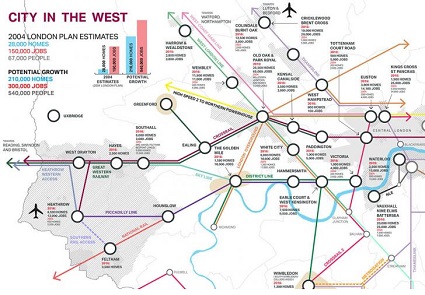
City in the West is a joint initiative supported by the Greater London Authority, Transport for London, local councils in west and south west London, and various public and private sector investors. One of the key objectives of the City in the West plan is to consolidate a number of local planning and development projects, such as the Western Wedge or the Western Access Corridor. Other important objectives include the delivery of substantial infrastructure improvements, the creation of jobs, and the construction of quality and affordable housing.

This plan could be considered as an ambitious extension of the London Plan. Whereas the 2004 London Plan contemplated the creation of 150,000 jobs in West London, the new plan sets its estimates at 300,000 jobs. Housing creation estimates have also been re-evaluated, going from 30,000 homes according to the 2004 plan to approximately 210,000. All in all, the Greater London Authority expects that more than 600,000 Londoners will directly or indirectly benefit from the new developments brought about by this plan.

Locations and Scope

The City in the West plan will be implemented across several Opportunity and Intensification Areas. Housing Zones have also been designated in boroughs located to the west and south west of central London. Key locations include: Continue reading “City in the West – London Plan”

What does the 2016 Budget mean for London businesses?

Over the past few days, the details and potential impact of the 2016 Budget have been one of the most discussed topics throughout the United Kingdom in general and among London-based businesses in particular. The British capital has always been considered the country’s main economic engine and a hub for entrepreneurship and innovation, and many predicted that the Budget would focus on solidifying the city’s prominent position in this respect, fostering a culture of investment and enterprise.

Continue reading “What does the 2016 Budget mean for London businesses?”

London Office Space Growth Areas 2015: Whitechapel

In close proximity to London’s major financial district Bishopsgate, Whitechapel is quickly rising as a prominent spot for growing businesses. Alongside this excellent locale, Whitechapel is serviced by numerous travel links. Using these links – whether taking the one of the numerous bus lines that service the area or hopping on the underground – Liverpool Street is only 6 minutes travel, while Canary Wharf is only 20. Another advantage of the Whitechapel area is that, as it is approximately three and a half miles from the city centre, the majority of it is outside the congestion area.

The current position of London office space has reached a plateau after a period of growth following a stagnant period. Confidence in the London market remains at a comfortable high, despite the general referendum occurring in 2015. However, as construction rates begin to level off, West End rental rates have begun to rise significantly. As a result of this, many new and already established businesses look to areas of London which have been previously undiscovered – such as Whitechapel. Having transport services to the city centre and other business parks as easily found as those in Whitechapel makes this region an in-demand location. Continue reading “London Office Space Growth Areas 2015: Whitechapel”

London Office Space Growth Areas 2015: King’s Cross

Despite high political tensions in 2015 as general and mayoral elections loom – and particularly as the EU referendum comes ever closer – confidence in London as a commercial hub appears to remain stable. However, construction levels are slowly coming to a standstill as projects finish and no new ones begin, causing rental rates in the West End to begin rising significantly. As such, businesses looking for commercial property in London are beginning to broaden their horizons in terms of office markets.

London office space rates remained at a steady level in 2014, with investments totalling just under £20 billion being pumped into the sector. That being said, 2014 ended with some surprises as some of London’s ‘trophy assets’ were seen to change hands – for example the famous Gherkin, which was purchased last year by the Brazilian/New York dynasty Safra. Indeed, with rental prices continually on the increase, a second surprise was seen as some of the previously more obscure sub-markets of London began to billow with success. Continue reading “London Office Space Growth Areas 2015: King’s Cross”