Innovative Meeting Spaces in London.

London tops the list of the 25 best meeting destinations in Europe, hosting hundreds of conferences, congresses, and professional events every year. The city’s venues cater to every industry sector and accommodate meetings of all sizes, from meeting rooms for small gatherings to large venues capable of accommodating thousands of delegates. Among all this choice, we highlight some of the most innovative and unique meeting spaces in London.

1. Plexal

Plexal is an innovation centre and workspace built in 2017 to provide space for the development of cutting-edge ideas. The building is often chosen for hackathon’s, tech events, and meetups for the creative and tech sectors. Meeting space is suitable for events of up to 300 people, and stands out for the quality of its dedicated event technology. Cutting edge equipment like 3D printers come as a standard, as do large projection screens and monitors and bespoke lighting.

Another way in which Plexal stands out from other meeting venues is its indoor park. This unique space has been specifically created to host informal events, but can also double as a breakout area. Sitting is arranged in bleachers, loungers, deck chairs, even bean bags.

Continue reading “Innovative Meeting Spaces in London.”

London Office Space in Strong Demand

Demand For Office Space In London

London is a premium office market at a global level, and as such, demand for office space in the British capital is always on the rise. Demand for office space in London is evenly distributed across three sub-market categories:

Established markets are in centrally located areas, like the City of London, London Bridge, Canary Wharf, Tech City/ Shoreditch, Aldgate, and Clerkenwell. In the West End, in-demand sub-markets include Westminster, Paddington, St James, and Mayfair. Other more recently established office markets are King’s Cross and Southbank.

Up-and-coming or emerging office sub-markets are mainly located in South and East London. In South London, demand is stronger in Battersea, Vauxhall, Nine Elms and the Greenwich Peninsula, where many new high-spec offices are being built alongside residential buildings. Continue reading “London Office Space in Strong Demand”

Digital Business Guide

London has an enviable position in both finance and business services globally, but it is also one of the most important places in Europe as a creative city and one which drives the worldwide media agenda. This has traditionally been in the field of publishing and conventional broadcasting, along with a relatively minor film industry. However, these days the capital’s creative industries are increasingly run by digital businesses. Given that so much of the business world, including the financial services sector, are now also reliant on digital transactions and products, digital businesses are now only likely to grow in importance as contributors to the city’s wealth.

According to the Greater London Authority’s Intelligence Unit, the city is well placed in the information revolution which has seen the growth of entirely new industries, as well as the transformation of well-established ones. In a report into London’s digital economy, they said that the opportunities for the cross-pollination of innovative ideas in the digital business world will be bolstered by London’s world-class universities. In addition, the report continues, the capital’s highly-skilled will add to the attractiveness of London as a base for digital industries, even web-based corporations from overseas.

If the capital is to continue to lead the world in the innovative digital industries of the future, it is of huge importance that businesses based in London have access to a digital communications infrastructure which is fast-moving and able to compete on a global stage. The authorities in London recognise that the city must improve its digital connectivity. Indeed, the Greater London Authority has said that it must cooperate with London’s boroughs in order to push this agenda forwards. According to Kulveer Ranger, the Mayor’s Director of Digital London, his organisation is working with the other local government in London to bring about greater WiFi connectivity in the capital and to reduce pressure on the struggling 3G network. This, he said, includes the introduction of WiFi on the London Underground network which should enable Londoners to digital services online, even when they are travelling around beneath the city’s streets. Continue reading “Digital Business Guide”

Virtual Office Space – How to Secure a Premium London Business Address Without Paying a Premium Price

Choosing a virtual office is an effective way of securing a premium London business address without paying a premium price. Some key benefits of going for this type of service include:

  • Having a virtual presence in a global city
  • Being able to choose among various premium addresses without having to pay for prime real estate
  • Having more time to focus on running your business
  • Saving on the costs of software, office equipment, and staff

Virtual Offices in London: Services Included

Virtual offices provide a registered address that can be used with the Companies House and in company stationery, as well as mail reception and mail forwarding to UK addresses and in some cases abroad too. Mail can be also be scanned, faxed, or collected in person.

Another common service is personalised phone answering, message taking, and call forwarding. Remote access to voice mail may also be available.

If virtual offices are provided by business centre operators, access to hot desks and meeting rooms is usually part of the package. Where the service provider has an international presence, access to business lounges in other cities or countries and invitations to networking events may be included.

Other services include secretarial and admin support (e.g. transcription, translation, booking appointments, event management, making travel arrangements, etc.). These are often available on a pay-per-use basis.

Choosing a Virtual Office Address

When choosing a virtual office address, it’s important to bear in mind that certain industry sectors are clustered in specific parts of the city (e.g. creative and media in Clerkenwell and Shoreditch, finance and banking in the City, small IT operations around Great Titchfield Street, or logistics and distribution in West London).

Continue reading “Virtual Office Space – How to Secure a Premium London Business Address Without Paying a Premium Price”

Overview of the London Commercial Property Market 1st Quarter 2017

Sustained rental value growth has been the predominant theme in the London commercial property market during the first quarter of the year. On the whole, Q1 2017 can be described as positive and with no significant changes with regards to the previous quarter.


London
Office Market Q1 2017

Take-up rates in Central London doubled in Q1, reaching 1 million square feet in February. These were particularly high in Southbank, where vacancy rates dropped to their lowest point in the past 18 months, reaching 3.3 per cent. Central London take-up by sector remains unchanged, with media and tech occupiers on the lead, followed by the public sector, finance, and business services. Grade A vacancy rates ranged between null values in Aldgate to 15 per cent in Holborn.

Total availability increased by 4 per cent to 14.7 million square feet, although most supply is clustered around King’s Cross, Paddington, Stratford, and London Bridge.

Rental values grew by 0.2 per cent across the city. The lowest average rents are currently £40 / sq ft in Stratford and £47.50 in the Docklands, whereas the highest are in St James and Mayfair (£110 / sq ft), Soho, Belgravia, and Knightsbridge, ranging from £85 to £87.50.

However, the introduction of higher business rates in April may reverse the generalised upward trend. This will be most evident in the legal sector, which has also been affected by increases in annual rent costs, reaching 5 per cent over a five-year period. The business rates revaluation may lead to a decreased enquiry volume in sub-markets affected by the sharpest increases, namely Clerkenwell, Camden, Shoreditch, King’s Cross, and West City. Continue reading “Overview of the London Commercial Property Market 1st Quarter 2017”

Considering a Move to the Award Winning Chiswick Business Park?

Chiswick Business Park is an award-winning commercial property development that offers first-class office and retail space along with multiple leisure amenities. This development has received numerous awards since 2001, the most notable of which include the 2002 British Construction Industry Award, the 2003 RIBA Award, the 2011 Best Business Award for Best Customer Focus, the 2012 Financial Times Top 50 Workplaces in the UK, the 2013 Queen’s Award for Enterprise and Sustainable Development, and the 2016 Green Apple Award.

Currently, the park consists of 11 buildings that occupy nearly 1.5 million square feet, although further development is expected given that the park’s developers have planning consent to build a total of 1.8 million square feet. Some of the features that characterise the space available at the park include floor-to-ceiling heights of 9.8 feet, open plan floor plates, VAV and air displacement heating and air conditioning systems, ample parking space, smart building automation and monitoring systems, and CCTV. Moreover, the park is known for its commitment to green practices, evident in the presence of sustainable washrooms and the recycling of food, green waste, and rainwater.

Amenities

This business park offers a wide range of amenities in addition to state-of-the-art commercial property space, including on-site coffee shops, restaurants, bars, and shops. On the leisure front, tenants have access to a Virgin Active fitness club, landscaped outdoor areas suitable for pedestrians and cyclists, dedicated outdoor space for corporate events, and annual sports events organised by the companies headquartered here. A miniature golf course is 1.6 miles away, and the park is only a few minutes’ walk from the Gunnersbury Triangle Nature Reserve, which provides tenants with opportunities to unwind in a pleasant natural environment. Continue reading “Considering a Move to the Award Winning Chiswick Business Park?”

London’s Ever-Changing Skyline And Its Implications For The Office Rental Market

London’s skyline and its blend of traditional and modern architecture is certainly representative of the city’s special relationship with its past and future. One of the most distinctive traits of the city’s skyline is its surprisingly low number of high rises, especially when compared to other global cities with a large population and high levels of economic activity. Makeover plans were put on hold or abandoned altogether during the financial crisis, and in other cases they were met with opposition from residents and consumer groups. But recently, an impressive number of development plans have received the go ahead, and in early 2017 there were 119 high rises in the city’s development pipeline. Submissions for planning permission increased by 30 per cent in just one year, and many affirm that the city’s skyline will the fully transformed by 2025.

Which Areas Are More Likely To Be Transformed?

London’s vertical transformation will be most evident in the City and East London. Tower Hamlets will be thoroughly transformed, as there are 93 high rises in the borough’s development pipeline. This area will be home to the city’s tallest skyscraper, once the 75-storey Landmark Pinnacle is completed. Moreover, the construction of the impressive Bishopsgate 22 and 1 Undershaft may make the Gherkin invisible, and similar developments are planned in Isle of Dogs (with the 45-storey Baltimore Tower), the EC3 postcode (with the Scalpel Tower, 100 Bishopsgate, and 60-70 St Mary Axe).

The city’s skyline will also bring a new visual identity to areas outside the city core. Shoreditch will consolidate itself as a major business district with developments like Bishopsgate Goodsyard, Principal Tower, and the Stage. Southwark will have 26 new high rises, and Lambeth and Newham will not be left behind with 32 each. Other areas whose skyline is likely to change include Croydon, Barnet, and even West London, particularly in Chelsea, Hammersmith and Fulham. Continue reading “London’s Ever-Changing Skyline And Its Implications For The Office Rental Market”

Overview of the London Commercial Property Market in 2016

During the last quarter of 2016, and much in line with the rest of the year, a cautious approach has been the predominant theme in London’s commercial property market. Broadly speaking, the market saw a consolidation of the trends that were evidenced earlier in the year, namely weak occupier demand (particularly in the office sector), moderate rental growth levels, and a surge in the number of occupiers looking for flexible lease terms.

Office Market

Political uncertainty and fluctuations in the value of the pound caused a slow-down of the office market during Q4. However, while take-up rates were down when compared to the long-term average, they noticeably picked up towards the end of the year. With regards to the causes behind this slow-down, market analysts at Green Street Advisors have drawn attention to factors other than the current political climate. For instance, the implementation of advanced technologies and automation is expected to have far-reaching effects in industry fields that are considered major office occupiers, ranging from finance to customer service.

The main office market indicators behind end-of-year data showed that Grade A absorption and take-up rates were down when compared to the city’s 10-year average. At the same time, availability rates for office properties across the city increased, and rental values remained stable. Market indicators for West End office units followed this pattern with the exception of rental rates, which evidence a slight decrease of 5.2 per cent, mainly in Marylebone, Knightsbridge, and Bloomsbury. In other parts of the West End, rental values remained stable thanks to a combination of flexible incentive packages and low vacancy rates. The highest rental rates were in Mayfair and St James’ (£118 / sq ft), whereas the lowest were in Paddington and Bloomsbury (£67.50 and £68.50 respectively). Vacancy rates were at their highest in St James’ (close to 10 per cent), Paddington and Bloomsbury (6 per cent). Key occupiers were business services, media, tech, and finance. Continue reading “Overview of the London Commercial Property Market in 2016”

City in the West – London Plan

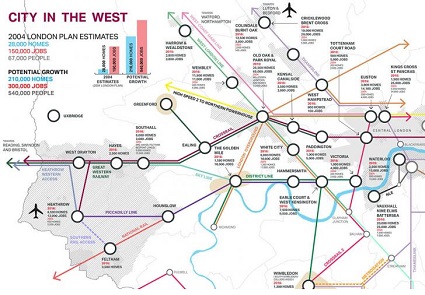
In the autumn of 2015, the former mayor of London Boris Johnson announced an ambitious urban development plan for the British capital. The project (which in fact consists of two different but interrelated plans known as City in the East and City in the West) aims to create a more balanced distribution of economic and commercial power within the UK’s capital city.

Over the past decade, development plans in West London have been somehow overlooked, since most of the work has been directed at transforming East London and getting this area ready for the Olympics. The City in the West Plan was created to address this situation and to help tap into the potential of West London and turn it into one of the most desirable places to live and work.

City in the West: Overview and Key Figures

City in the West is a joint initiative supported by the Greater London Authority, Transport for London, local councils in west and south west London, and various public and private sector investors. One of the key objectives of the City in the West plan is to consolidate a number of local planning and development projects, such as the Western Wedge or the Western Access Corridor. Other important objectives include the delivery of substantial infrastructure improvements, the creation of jobs, and the construction of quality and affordable housing.

This plan could be considered as an ambitious extension of the London Plan. Whereas the 2004 London Plan contemplated the creation of 150,000 jobs in West London, the new plan sets its estimates at 300,000 jobs. Housing creation estimates have also been re-evaluated, going from 30,000 homes according to the 2004 plan to approximately 210,000. All in all, the Greater London Authority expects that more than 600,000 Londoners will directly or indirectly benefit from the new developments brought about by this plan.

Locations and Scope

The City in the West plan will be implemented across several Opportunity and Intensification Areas. Housing Zones have also been designated in boroughs located to the west and south west of central London. Key locations include: Continue reading “City in the West – London Plan”

Overview of the London Commercial Property Market – 3rd Quarter 2016

London Office Space Market

Q2 2016 ended on a note of uncertainty due to the unexpected result of the Brexit vote. Researchers suggest that the vote had a direct effect on the activity levels of the London office market, although the effects were far from dramatic given that most of the transactions in the local market consisted of pre-lets deals that had been completed before the referendum. On the whole, the third quarter of 2016 has been characterised by the ongoing decrease in the availability of Grade A space. Citywide, vacancy rates are considerably lower than the decade’s average at just over 4 per cent. The only office sub-markets where availability levels are above 5 per cent are Clerkenwell, Holborn, and St James. By the end of the year, it is expected that approximately 4.6 million square feet will be delivered across London, which may bring a temporary relief to the tight supply-demand ratio (1).

Following the Brexit vote most investors have taken a cautious approach, as they have decided to put decisions on hold to evaluate how current market conditions will play out in the short and medium term. As a result, there have been no changes in yields when compared to the previous quarter, staying at around 4 per cent citywide and 3.25 per cent in the West End (2). However, some have suggested that further investments may be hindered in the near future based on the evolution of UK-EU relations, as it may become harder for investors to borrow funds and obtain credit and this could lead to a drop in overall investment volume (3).

During Q3, prime office rents have remained mostly unchanged in the majority of office sub-markets, averaging £70 / square foot in the City and £125 / sq ft in the West End. The priciest rental values could be found in Mayfair, St James, Marylebone, Knightsbridge, whereas the lowest apply to properties in the Docklands, Chiswick, Aldgate, and Shoreditch. On the whole, rental growth is expected to flatten until the end of the year, although demand may tighten up in areas like Fitzrovia, Soho, Noho, and the City, where total occupational costs are likely to reach £114 / square foot by 2018. In fact, the only sub-markets where total occupational costs may remain below the £100 / sq ft mark are Aldgate and Canary Wharf. The biggest rental value fluctuations on a year-on-year basis apply to office properties in Canary Wharf, the Eastern City Fringe, Hammersmith, and King’s Cross (4).

The most notable deals within the office market involved properties in Canada Square, Cannon Street, Holborn, King’s Cross, and Victoria. Take-up volume was at its highest in the City, with 43 per cent of the total, followed by the West End (27 per cent), Docklands (12 per cent), Midtown (11 per cent), and to a lesser extent, in Southbank and Hammersmith (5).

London Retail Market

According to some market analysts, the depreciation of sterling with respect to the euro and other foreign currencies has been somehow beneficial to the retail sector in London, and especially in central London due to the area’s traditionally high tourist footfall levels. During the third quarter of the year, there has been a surge in expenditure in shops, restaurants, and hotels, partly due to the onset of the summer season (6). West End retailers have been largely unaffected by the Brexit vote, as more than 60 per cent of all shoppers in this area are international visitors, although it is still unclear how domestic consumer confidence will be affected in 2017 and beyond (7).

During the month of August, prime retail rent records were broken following the deal signed by Spanish retailer Desigual for a property in Oxford Street. This transaction’s value reached £1.5 million (or £700 / sq ft / year), a figure that is significantly higher than the area’s average at £575 / sq ft / year (8). Luxury retail locations within Central London remain attractive to foreign investors. The most important retail deal of this quarter involved the sale of a 50,000 square feet building in New Bond Street for nearly £200 million (9).

Investment yields for retail properties remain stable, ranging between 4 and 5 per cent for prime retail and shopping centre properties (10).

Industrial Market

Throughout Q3, the industrial property sub-market within the Inner M25 continued to perform strongly, mainly due to robust demand and limited supply of standard industrial properties and distribution warehouses. The main industrial property hotspots are near Heathrow and in parts of Greater London like Croydon, where multi-let and big box units continue to be in high demand thanks to the strong performance of the e-commerce sector. Average prime rents for industrial properties in industrial parks near Heathrow reached £14 / square foot / year, which represents an increase of nearly 8 per cent over last year’s figures. In Croydon, rental rates for standard industrial properties average £11 / square foot / year, and in the rest of Greater London prices remain stable or have only experienced modest increases.

Market analysts predict that in the short term, rising investment returns are likely to turn the industrial sector into the best performing of all sub-markets. According to the forecast, yields for industrial properties within the M25 may exceed 7 per cent by 2020, as many of them are already returning yields of nearly 6 per cent. It is also expected that sterling devaluation will result in the growth of export manufacturing activities, which in turn will have a direct impact on the local industrial property market (11).

Sources:

(1) http://www.cbre.co.uk/uk-en/research

(2) http://www.cushmanwakefield.co.uk/en-gb/research-and-insight/uk/united-kingdom-office-snapshot/

(3) http://www.savills.co.uk/research_articles/173552/205429-0

(4) http://www.colliers.com/-/media/files/emea/uk/research/offices/201605_londontechmarketmonitor.pdf?la=en-GB

(5) http://www.cluttons.com/sites/default/files/documents/london-office-market-bulletin-summer-2016.pdf

(6) https://www.theguardian.com/business/2016/sep/23/spending-by-visitors-to-uk-tourism-rose-2-per-cent-in-july

(7) http://pdf.euro.savills.co.uk/uk/commercial-retail-uk/the-impact-on-the-uk-retail-market-21-july-2016.pdf

(8) http://www.independent.co.uk/news/business/news/oxford-street-shop-rents-shattered-by-record-deal-with-spanish-retailer-2058627.html

(9) http://www.propertyweek.com/news/oxford-properties-and-richemont-buy-new-bond-street-property-for-%C2%A3198m/5085320.article

(10) https://kfcontent.blob.core.windows.net/research/103/documents/en/q3-2016-4074.pdf

(11) http://www.colliers.com/-/media/files/emea/uk/research/research%20and%20forecasting/201609_reifq3.pdf?la=en-GB