
West London Office Space Rental Costs & Vacancy Rates 2021

The West End is one of London’s prime areas for commercial real estate. This market has also been one of the most severely affected due to pandemic-related restrictions, which were felt sharply in addition to the uncertainty created by Brexit.

At the start of 2021, the general situation in the West End was marked by a 91% increase in availability compared to the previous year’s figures. More than 7 million square feet of office space were available in Q1 2021. Vacancy rates for the whole of West London were estimated at just over 8% in early 2021, which is double the rate of the Q1 2020 figure.

Both factors combined led to a slight decrease in prime headline rents, which were calculated at an average of £110 per square foot in Q1 2021. The downward trend in rental values is expected to continue into 2022 with a rent decline forecast between 7.5% and 12.5%.

The majority of deals that recently took place in this market came from the professional services sector and involved small offices of 5,000 sq ft and under. On the whole, occupiers still hesitate to commit to large spaces and/or long leases.

Continue reading “West London Office Space Rental Costs & Vacancy Rates 2021”

City of London Office Space Rental Costs & Vacancy Rates 2021

2021 started off with gloomy forecasts for the London commercial property market. According to market analysts, the outlook for the first half of the year was to be dominated by soaring vacancy rates, which were expected to reach a 10-year-high.

In Central London, changes to vacancy and supply rates have certainly been a constant for the past few quarters. In this part of the city, increasing vacancy rates have been mainly driven by the release of large amounts of secondary and Grade B space.

Earlier in the year, vacancy rates in the City were slightly over 10%, but supply was still rising, so they were expected to continue increasing. However, the second quarter arrived with a decline in vacancies, which ended up averaging 8.7% across the City. Despite the improvement, at more than 6.5 million square feet, these are the highest availability rates since mid-2012.

The second quarter of the year also brought some improvement in office take up rates. While these are still significantly below the ten-year average, there was a quarterly increase of over 20% across central London.

However, demand remains rather weak and take up for Central London offices is largely down when compared to 2020 figures. Although demand is weaker, it is still there with an increased focus on quality office space, whether it is new, refitted, or retrofitted to a high standard. The majority of demand so far has come from the public sector, professional services, insurance, and financial services companies.

Continue reading “City of London Office Space Rental Costs & Vacancy Rates 2021”

Overview of The London Commercial Property Market Q2 2021


2021 started at a sluggish pace for the London commercial property market. During the second quarter of the year, the market evidenced signs of recovery. Office, retail, and industrial markets registered an uptick in activity starting in April.

The main themes observed this quarter were:

  • A strong appetite for high-quality office and industrial space.
  • Growing investment volumes.
  • Vacancy rates kept increasing, but they’re still lower than expected.

Office Market

The London office market started to show signs of recovery during the second quarter of the year. Investment volume totalled more than £2.5bn, confirming the renewed confidence of investors in the future performance of the city’s office market.

Transaction levels were up, with most transactions involving Grade A space, sub-lets and dominated by the creative, technology sectors, non-profit and public sectors. Large transactions centred around the EC2 and SE1 postcodes.

Continue reading “Overview of The London Commercial Property Market Q2 2021”

Overview of The London Commercial Property Market Q1 2021

The London commercial property market entered 2021 surrounded by uncertainty. Weak economic fundamentals and pandemic-related disruption affected every sub-sector, although in different ways. During the first three months of the year, the following themes emerged:

  • Weak demand for office space with take-up rates below the 10-year average, which were balanced by exceptional demand for large industrial properties.
  • Excess retail space continued pouring into the market, with the exception of retail businesses deemed essential (i.e., homewares, grocery, and discount shops).
  • A sustained flight-to-quality, which was more evident in the office sub-market but also present in industrial properties.

Overall, the market was stable and showed greater resilience than expected. The quarter ended on a strong note and displaying moderate signs of improvement. Continue reading “Overview of The London Commercial Property Market Q1 2021”

How to Value a Commercial Property and Determine Rent in London

London serves as a hotspot for commercial property and is known to have one of the most competitive real estate markets in the world, with a wide variety of providers and prospective occupants interacting daily to ensure that businesses conduct their work in an ideal environment. Due to this competitiveness, it is vital that businesses understand pricing dynamics before signing a lease for an office space, retail shop, or industrial premises in the British capital. In this post we will examine how commercial property in London is valued and how these valuations impact rental rates.
What is a Commercial Valuation?

Valuation is a process that aims to determine the value of a commercial building. This process often occurs when a property changes hands (either by being sold or leased), or for tax and insurance purposes. As a prospective tenant, understanding the valuation process can help you determine if the price of the property you’re interested in is fair and competitive.

Continue reading “How to Value a Commercial Property and Determine Rent in London”

Overview of The London Commercial Property Market 2nd Quarter 2020

Following the slowdown of the London’s commercial real estate market due to onset of the Covid-19 pandemic, activity levels have resumed during Q2, although cautiously. Transactions proceeded very slowly over the past three months, since fewer lenders are active and most tenants are on a wait-and-see mode. As a result, only a handful of transactions took place between April and June.

According to market analysts, it is still too early to quantify the true impact of the pandemic on commercial real estate, but the following observations ring true for the city: Continue reading “Overview of The London Commercial Property Market 2nd Quarter 2020”

London Commercial Property Market 1st Quarter 2020

London’s commercial property market entered 2020 with forecasted supply constraints and substantial rental growth. During the initial weeks of Q1, the market moved as anticipated.

Offices

Take-up levels were off to a slow start of the year, which translated into above-average availability. Average vacancy rates in Central London neared 4%, but they increased to 10% in East London. Office take-up in the West End and the Tech Belt remained stable. The business services sector was behind most transactions, accounting for approximately a third of all deals during Q1. Other key occupiers were banking, finance, technology, and creative.

The largest deal of the quarter involved offices in the EC2 postcode, although overall, the City of London remained the most sought-after destination. Outside of the City, Hammersmith and White City commanded the largest number of enquiries.

Continue reading “London Commercial Property Market 1st Quarter 2020”

Will the Pandemic Change the Rules of Office Space Size?

One of the key considerations for office-based businesses is making sure that workspace is efficiently allocated. Over the years, we’ve reached some consensus over what’s the best square metre-to-employee ratio. But with the recent developments brought about by the Covid-19 pandemic, things may be just about to change.

In this post we’ll take a look at the current rules of thumb on office space size and whether this will be affected by the pandemic.

How Much Space Is Enough?

Continue reading “Will the Pandemic Change the Rules of Office Space Size?”

London Commercial Property Fact Sheet and Infographic

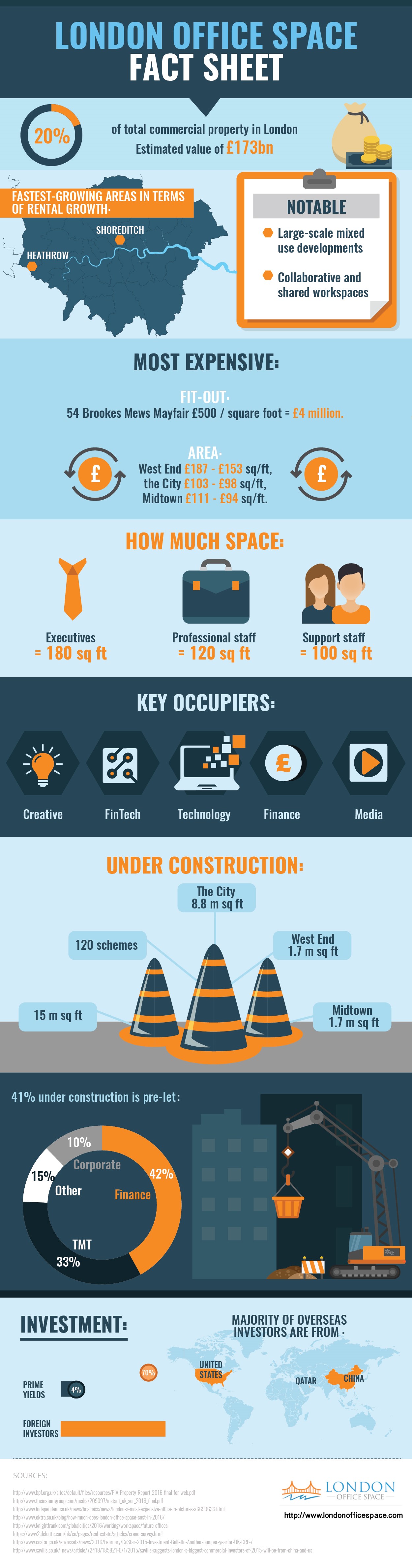
The London commercial property market is one of Europe’s largest both in terms of size and worth. Below you will find a wealth of data that provide a snapshot of the market in the UK’s capital city.

Offices

London offices account for 20 per cent of the city’s total commercial inventory, with an estimated value of £173bn. The fastest-growing areas in terms of rental growth include Heathrow (which currently already has more office square footage than Birmingham’s CBD) and Shoreditch, a formerly industrial area which is now a hotspot for media and tech companies.

Continue reading “London Commercial Property Fact Sheet and Infographic”

Overview of the London Commercial Property Market in 2016

During the last quarter of 2016, and much in line with the rest of the year, a cautious approach has been the predominant theme in London’s commercial property market. Broadly speaking, the market saw a consolidation of the trends that were evidenced earlier in the year, namely weak occupier demand (particularly in the office sector), moderate rental growth levels, and a surge in the number of occupiers looking for flexible lease terms.

Office Market

Political uncertainty and fluctuations in the value of the pound caused a slow-down of the office market during Q4. However, while take-up rates were down when compared to the long-term average, they noticeably picked up towards the end of the year. With regards to the causes behind this slow-down, market analysts at Green Street Advisors have drawn attention to factors other than the current political climate. For instance, the implementation of advanced technologies and automation is expected to have far-reaching effects in industry fields that are considered major office occupiers, ranging from finance to customer service.

The main office market indicators behind end-of-year data showed that Grade A absorption and take-up rates were down when compared to the city’s 10-year average. At the same time, availability rates for office properties across the city increased, and rental values remained stable. Market indicators for West End office units followed this pattern with the exception of rental rates, which evidence a slight decrease of 5.2 per cent, mainly in Marylebone, Knightsbridge, and Bloomsbury. In other parts of the West End, rental values remained stable thanks to a combination of flexible incentive packages and low vacancy rates. The highest rental rates were in Mayfair and St James’ (£118 / sq ft), whereas the lowest were in Paddington and Bloomsbury (£67.50 and £68.50 respectively). Vacancy rates were at their highest in St James’ (close to 10 per cent), Paddington and Bloomsbury (6 per cent). Key occupiers were business services, media, tech, and finance. Continue reading “Overview of the London Commercial Property Market in 2016”